
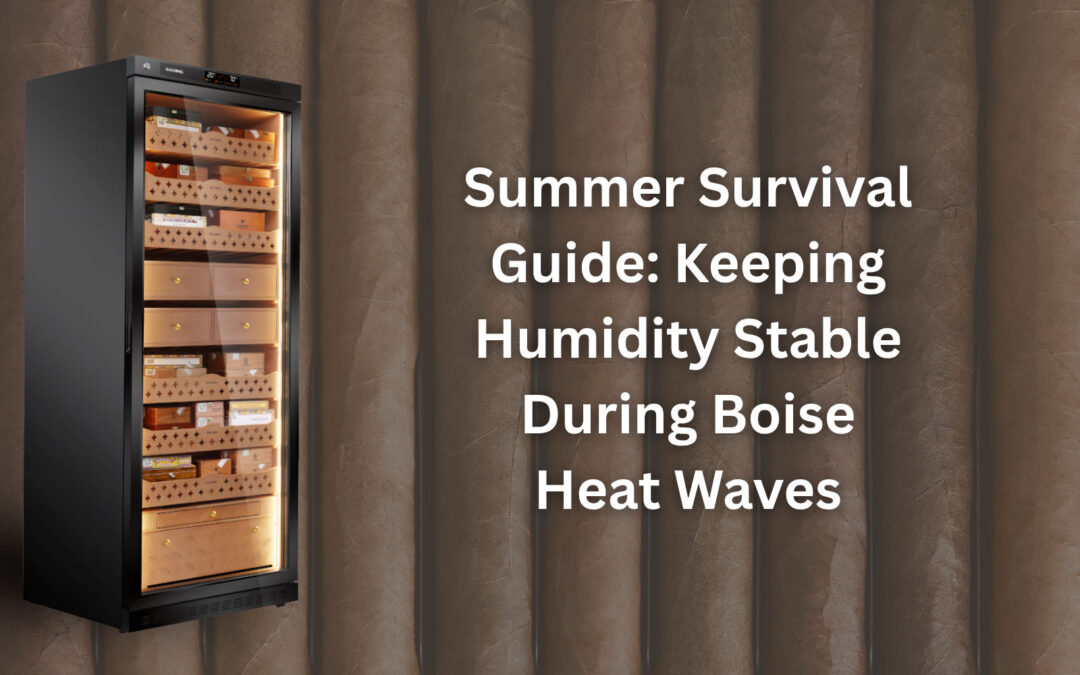
At Lucky Duck Humidors in Boise, we talk to Treasure Valley cigar collectors every summer who watch their traditional humidors struggle the moment the first real heat wave arrives. July and August routinely push daytime highs into the mid-90s and beyond, while relative humidity often crashes into the 20–30% range (and sometimes lower). That combination of high heat and bone-dry air is one of the toughest environments in the country for passive storage.
Your cigars don't care that it's a beautiful day on the Boise River. They only care about the environment inside the box.
The Dry-Air Challenge in the Treasure Valley
When outdoor humidity plummets, a traditional wooden humidor has almost no defense. The seal is imperfect, the humidification device (beads, gels, or a small sponge) has limited capacity, and the wood itself starts giving up moisture to the dry room air. The result is a slow, steady drop in relative humidity inside the box. Wrappers tighten, oils migrate poorly, and the aging process stalls or reverses.
Even worse, many basements and game rooms in the Treasure Valley warm up more than people realize during multi-day heat events. Temperature and humidity are linked: warmer air holds more moisture, so a rising temperature can mask a falling RH until the problem is already well underway.
This is exactly why so many local collectors eventually move to active climate control.
Water Reservoir Management on Raching Units
Raching MON-series cabinets are built with oversized water reservoirs (approximately 7.2 liters / nearly two gallons on most models). That large capacity is one of the biggest practical advantages during Idaho summers. Many owners report going two to three months or longer between refills under normal conditions.
Here's how to manage the reservoir for peak summer performance:
- Always use distilled or purified water. Tap water introduces minerals that can clog the humidification system over time and leave residue on the sensors.
- Top off when the unit prompts you, not before. Raching units clearly indicate low water. Overfilling can cause issues; underfilling forces the system to work harder.
- Keep the funnel and siphon tools handy. These come with the unit and make the process clean and quick. Remove shelves if needed so you can pour without spilling.
- Monitor more frequently during extreme heat. Even with a large reservoir, sustained low ambient humidity means the unit will use water slightly faster. A quick check every couple of weeks during a heat wave is smart insurance.
- Never let the reservoir run completely dry. Running dry stresses the system and can temporarily throw humidity control off while it recovers.
Because the humidification is active and distributed (often described as nano-scale cloud humidification), moisture is delivered evenly without the wet spots or dry pockets common in passive boxes.
Why Active Cooling Matters When Humidity Crashes
Passive humidors and even many thermoelectric units are limited by the temperature of the room. When your home or basement climbs into the upper 70s or 80s, those systems simply cannot keep the interior in the ideal 16–22°C (60–71°F) range. Higher temperatures accelerate chemical changes in the tobacco and, in extreme cases, raise the risk of tobacco beetle activity.
Raching cabinets use active cooling (compressor-based or advanced semiconductor systems depending on the model) that operates independently of room temperature. The unit can hold a stable 64–68°F interior even when the room is significantly warmer. That temperature stability has a direct effect on humidity control:
- Cooler air requires less moisture to reach the same relative humidity target.
- The system can humidify more efficiently and recover faster after door openings.
- Combined with ±1% RH precision and multiple sensors, the cabinet maintains the 60–75% range without the wild swings that damage cigars.
In short, active cooling doesn't just keep the temperature safe — it makes humidity control far more reliable when the outside air is trying to suck every bit of moisture out of your collection.
Practical Summer Checklist for Treasure Valley Collectors
- Place the cabinet away from direct sunlight, exterior walls that heat up, and HVAC vents that blow hot, dry air.
- Keep the door closed as much as possible during the hottest part of the day.
- Check water level and actual RH/temperature readings at least every two weeks in July and August.
- Avoid opening the unit for extended inventory or reorganization during multi-day heat events.
- If you have a dual-zone or larger MON model, take advantage of the stable environment to continue long-term aging instead of "just trying to survive the summer."
The Bottom Line
Boise summers are tough on cigars stored the old-fashioned way. The combination of high heat and extremely low humidity exposes every weakness in a traditional humidor. Raching cabinets solve the problem at the source with precise active cooling, a large water reservoir that rarely needs attention, and humidity control that stays locked in even when the Treasure Valley is baking.
If your current setup is fighting the summer climate (or if you're ready to stop fighting it), stop by Lucky Duck Humidors in Boise. We're happy to walk you through the MON series, talk through placement in your specific space, and help you set the unit up so your collection stays protected through the hottest months of the year — and every season after.